

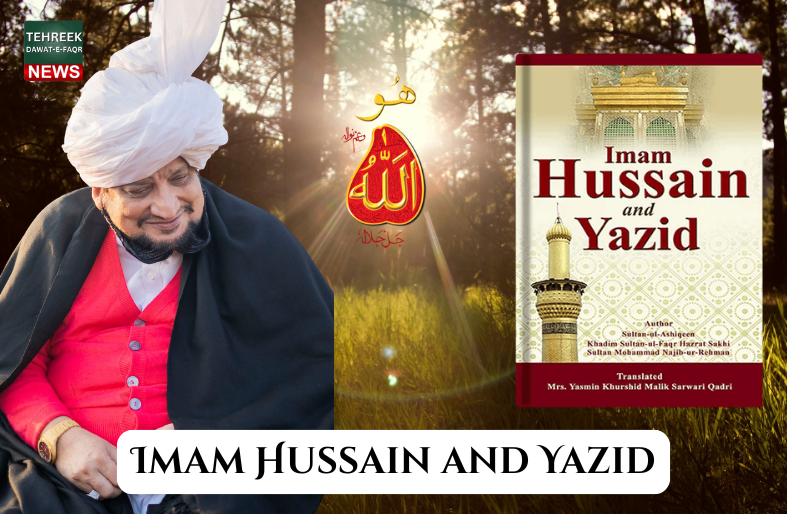
Lahore — 16 April 2026: Imam Hussain and Yazid represent two eternal and universal forces that exist in every era — the force of Divine Truth and the force of falsehood. The battle of Karbala was not simply a historical event. It was the greatest manifestation of Faqr, Ishq and complete surrender to the Will of Allah ever witnessed by humanity. Sultan-ul-Ashiqeen, Hazrat Sakhi Sultan Mohammad Najib-ur-Rehman Madzillah ul Aqdas, reveals in his book Imam Hussain and Yazid the deep spiritual philosophy behind Karbala and presents five timeless lessons that every seeker of Allah must internalize today.
Imam Hussain and Yazid: The Eternal Battle Between Truth and Falsehood
The first lesson from the tragedy of Imam Hussain and Yazid is that the battle between truth and falsehood never ends. Yazid represented Pharaohism disguised in the garb of Islam — replacing justice with tyranny, brotherhood with class system and democracy with dictatorship.
Imam Hussain declared his stand in these words: “Whoever witnesses a ruler committing barbarism and breaking the bounds established by Divinity, and does not oppose it neither by his action nor his tongue, he would not get a nice abode in the hereafter.”
This declaration was not political. It was the words of the Insan-e-Kamil — the Universal Divine Man and Spiritual Leader of his era — who could never accept Yazidism. Sultan-ul-Ashiqeen teaches that Yazidism is not confined to history. It exists in every era in different forms. The seeker of Allah must recognize it and stand against it with the same courage and conviction that Imam Hussain demonstrated on the plains of Karbala.
The Faqr of Imam Hussain Was His Greatest Weapon
The second lesson is the most profound. Sultan-ul-Ashiqeen explains that Imam Hussain had complete spiritual power as the Insan-e-Kamil of his era. He possessed the power of Kun — if he had commanded, the River Euphrates would have flowed to his camps, the storms of Karbala would have annihilated Yazid’s army instantly.
Yet he chose not to use it. He surrendered completely to the Will of Allah and faced the enemy as an ordinary human being — hungry, thirsty, outnumbered. This was the essence of Faqr. Sultan Bahoo described this in his Punjabi poetry saying that the true lover is the one who surrenders before every Will of his Beloved Allah. Despite being bruised by hundreds of swords he never turns away from the path of Ishq. There is no one like Imam Hussain in the field of Ishq who got beheaded but did not disclose the secret of his Beloved.
This is Faqr in its most perfect and complete form.
The Repentance of Hurr — The Door of Tawbah Is Always Open
The third lesson is one of the most moving episodes in the entire story of Imam Hussain and Yazid — the repentance of Hurr Bin Yazid Riyahi. Hurr was the commander who first stopped Imam Hussain’s caravan and forced him toward Karbala. He was a famous warrior loyal to Yazid’s forces.
Yet on the morning of Ashura, his heart could not bear the weight of what he was about to do. His body shook with fear. He told his brother: “I am wavering between Hell and Heaven.” When he heard Imam Hussain calling for anyone willing to sacrifice his life for the Prophet’s family, Hurr rode toward the Imam, dismounted his horse and said with tears: “I am the same Hurr who confronted you. I seek pardon for my lapse and want to be included among your selected slaves.”
The great Imam placed his sacred hand on Hurr’s head and said: “O Hurr! The sincere repentance and true regret are always accepted in Allah’s Court. I accept your apology.”
This is one of the most powerful lessons of Karbala — that the door of sincere repentance is never closed regardless of how grave the sin. Hurr became a martyr that same day and his place in paradise was sealed.
Refusal of Bayat — The Line a True Momin Never Crosses
The fourth lesson is the absolute refusal of Imam Hussain to swear bayat to Yazid. From the moment Yazid’s letter arrived in Madina until the last moment of his life on the plains of Karbala, Imam Hussain never wavered. He declared clearly: “I am an obedient slave of Allah, how can I obey an enemy of Islam. I have been brought up by sacred parents, I cannot follow an evil person.”
Sultan-ul-Ashiqeen explains that as the Insan-e-Kamil and Imam-e-Waqt of his era, Imam Hussain could never take bayat of any other person. The possessor of the Divine Trust takes bayat from others — he does not give it. Had Imam Hussain submitted to Yazid, there would have remained no difference between Islam and Yazidism until the Final Day. His refusal drew the eternal line between truth and falsehood for all generations to come.
Karbala Was the Greatest Victory — Not a Defeat
The fifth and most important lesson that Sultan-ul-Ashiqeen highlights is that the world must understand Karbala as the greatest victory of Imam Hussain — not a defeat. Seventy two individuals faced twenty two thousand armed soldiers. The Ahl-e-Bayt were kept thirsty for three days. Every companion and family member was martyred one by one. Yet not a single one of them broke their loyalty or sought Yazid’s mercy.
As Sultan-ul-Ashiqeen states in his book: “The martyrdom of Hussain is in fact the murder of Yazid. Islam is enlivened after every battle of Karbala.”
Yazid thought he had won by shedding the sacred blood of the Prophet’s beloved family. In reality, Imam Hussain’s martyrdom became the eternal light that exposed Yazidism forever and revived the true spirit of Islam for all generations. Every era has its Hussain and its Yazid. The seeker of Allah must ask himself — which side am I on?
The living inheritor of the teachings of Imam Hussain and the path of Faqr today is Sultan-ul-Ashiqeen, Hazrat Sakhi Sultan Mohammad Najib-ur-Rehman Madzillah ul Aqdas, at Masjid e Zahra, Village Rangeel Pur Sharif, Sundar Adda, Multan Road, Lahore.
TDF News | Tehreek Dawat-e-Faqr 🌐 news.tehreekdawatefaqr.com
